Author: Haixiao Wang
As demonstrated in [1], expander graphs are a sparse graph that mimic the structure properties of complete graphs, quantified by vertex, edge or spectral expansion. At the same time, expander constructions have spawned research in pure and applied mathematics, with several applications to complexity theory, design of robust computer networks, and the theory of error-correcting codes.
This lecture is organized as follows. We introduce two different definitions of expanders in the first section, and then explore the relationship between them in second part.
17.1. Two Definitions
We start our discussion in expansion with two definitions of expansion: combinatorial and spectral. In the rest of this post, we consider an undirected graph  with
with 
, where self loops and multiple edges are allowed. Given two subsets  , the set of edges between
  and
and  is denoted by
  .
.
17.1.1. Combinatorial expansion
Intuitively, a graph  is an expander if subsets
  expand outwards into
  . In other words, all small subsets will have large boundary, respectively. Follow this intuition, we introduce the definition of boundary, based on edges and vertices respectively, to quantify the corresponding expansion.
Definition 1(Boundary):
- The Edge Boundary of a set , denoted by
 , is the set of edges
  , which is the set of edges between disjoint set and .
 - The Vertex Boundary of a set is a subset of vertices in adjacent to vertices in , denoted as
 .
.
Obviously, vertex boundary  is the same as the number of neighboring vertices of vertex sets . With those notations, we then define the expansion over the entire graph
  via maximizing over subsets .
Definition 2(Expander): For some ![\varepsilon \in [0, 1]](https://s0.wp.com/latex.php?latex=%5Cvarepsilon+%5Cin+%5B0%2C+1%5D&bg=FFFFFF&fg=000&s=0&c=20201002) , a graph with is an
, a graph with is an
 -edge-expander if
  .
.- -vertex-expander if
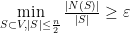 .
.
Remark 3: The reason for the restriction  is that we are examining the relative size of every cut in the graph, i.e., the number of edges crossing between and , and we examine each case only once.
Problem 1: Show that the complete graph  is
is
- at least a
 -edge-expander.
 - a
 -vertex-expander. (We only consider here.)
From the definition above, the maximum , which makes an -edge-expander, is an important criteria, leading to the definition of Cheeger constant.
Definition 4(Cheeger Constant): The Edge Expansion Ratio, or Cheeger constant, of graph with , denoted by  , is defined as

Remark 5: Actually, Cheeger constant can be defined alternatively as 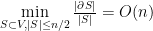 . We didn’t follow this definition since we want to keep
 ![\varepsilon\in [0, 1]](https://s0.wp.com/latex.php?latex=%5Cvarepsilon%5Cin+%5B0%2C+1%5D&bg=FFFFFF&fg=000&s=0&c=20201002) .
.
17.1.2. Spectral Expansion
To simplify our discussion, we focus on regular graphs in the rest of this lecture. Let  denote the adjacency Matrix of a
  -regular graph with and
  being real symmetric, then has
  real eigenvalues, denoted by
  , and corresponding orthonormal eigenvectors
  with
with  . The spectrum of encodes a lot of information about the graph structure. Recall the following properties, which we have seen in previous lectures.
- The largest eigenvalue is
 and the corresponding eigenvector is
  .
. - The graph is connected if and only if
 .
. - The graph is bipartite if and only if
 .
.
The definition of spectral expansion and spectral gap then follows.
Definition 6(Spectral Expansion): A graph with is a  -spectral-expander if
  .
.
In other words, the second largest eigenvalue of  , in absolute value, is at most . This also gives rise to the definition of Ramanujan graph.
Definition 7(Ramanujan graph): A connected -regular graph is a Ramanujan graph if  .
.
We now refer to the spectral gap.
Definition 8(Spectral Gap): The spectral gap of -regular graph is  .
.
Remark 9: Sometimes the spectral gap is defined as  , which is often referred as one-sided.
Problem 2:
- Show that the complete graph has spectral gap
 . Actually, we can also show that the one-sided spectral gap is .
 - Show that the complete bipartite graph
 has spectral gap
  . (Hint: use the spectral property above.)
17.2. Relating Two Definitions
It is not so obvious that the combinatorial and spectral versions of expansion are related. In this section, we will introduce two relations between edge and spectral expansion: the Expander-Mixing Lemma and Cheeger’s inequality.
17.2.1. The Expander-Mixing Lemma
Lemma 10(Expander-Mixing Lemma[2]): Let be a -regular graph with vertices and eigenvalues  . Then for all
  :
:

As we can see, the left-hand side measures the deviation between two quantities:
 : the number of edges between the two subsets and .
 : the expected number of edges between two subsets and , drawn from an Erdos–Renyi random graph
  .
.
The Expander-Mixing lemma tell us a small  (a.k.a. large spectral gap) implies that this discrepancy is small, leading to the fact that the graph is nearly random in this sense, as discussed in [1]. We should mention that the converse of expander-mixing is true as well, stated as follows.
Lemma 11(Expander-Mixing Lemma Converse [4]): Let be a -regular graph with vertices and eigenvalues satisfying:

for any two disjoint subsets  and some positive
  . Then
  .
.
Proof of Expander-Mixing Lemma: Recall that the adjacency matrix has eigenvalues with corresponding orthonormal eigenvectors . Let  and
and  be the characteristic vectors of subsets and (a.k.a., the
  -th coordinate of is if
  and otherwise). We then decompose and in the orthonormal basis of eigenvectors as
 .
.
Observing that  , we expand out the right hand side and apply orthogonality, which yields
 .
.
where the last step follows from the facts with corresponding  ,
,  and
and  . Shifting the first term on right hand side to the left, the desired result follows from Cauchy-Schwarz inequality:

Remark 12: If we normalize the adjacency matrix  and obtain
  , where each entry of is divided by , then the corresponding eigenvalues of
  , namely
  , lie in the interval
 ![[-1, 1]](https://s0.wp.com/latex.php?latex=%5B-1%2C+1%5D&bg=FFFFFF&fg=000&s=0&c=20201002) . The Expander-Mixing Lemma is in the form of
. The Expander-Mixing Lemma is in the form of

It is sometimes convenient to consider the normalized spectrum. For example in random graph theory, it would be convenient to look at the normalized spectrum when the expected degree  . However, we can focus on the spectrum of $\latex A = A(G)$ without normalization when the expected degree $\latex d = O(1)$.
Regular -spectral expanders with small (a.k.a. large spectral gap) have some of significant properties, listed as follows.
Corollary 13: An independent set , in a graph with , is a set of vertices , where no two vertices in are adjacent, i.e. with  . An independent set , in a -regular
  -spectral expander , has cardinality at most
  , i.e.,
  , which follows immediately from Lemma 10(Expander-Mixing Lemma[2]).
Corollary 14: Given a graph with , the diameter of is defined as  , where
  is the length of shortest path between
  and . If is a -regular -spectral expander with
  , then we have

17.2.2. Cheeger’s Inequality
As we have seen from previous discussion, spectral expansion implies strong structural properties on the edge-structure of graphs. In this section, we introduce another famous result, Cheeger’s inequality, indicating that the Cheeger constant(Edge Expansion Ratio) of a graph can be approximated by the its spectral gap  .[6]
.[6]
Theorem 15(Cheeger’s inequality, [3]): Let be a -regular graph with eigenvalues  , then
 .
.
In the normalized scenario  with eigenvalues
 ![\bar{\lambda}_{1}, \cdots, \bar{\lambda}_n \in [-1, 1]](https://s0.wp.com/latex.php?latex=%5Cbar%7B%5Clambda%7D_%7B1%7D%2C+%5Ccdots%2C+%5Cbar%7B%5Clambda%7D_n+%5Cin+%5B-1%2C+1%5D&bg=FFFFFF&fg=000&s=0&c=20201002) , we have
, we have
 .
.
Remark 16: The proof for the normalized scenario is different from the regular scenario. We should start from the desired quantity and finish the calculation step by step. However, the strategy are the same. We use the Rayleigh Quotient to obtain upper bound and lower bound.
In the context of  , the estimate of spectral gap was given by Nilli Alon.
Theorem 17([5]): For every -regular graph , we have

The  term is a quantity that tends to zero for every fixed as
  .
.
[1]. Shlomo Horry, N. L. and Wigderson, A. (2006). Expander graphs andtheir applications.BULLETIN (New Series) OF THE AMERICAN MATHEMATICAL SOCIETY, 43(4).
[2]. Alon, N. and Chung, F. R. K. (1988). Explicit construction of linear sized tolerantnetworks.Discrete Mathematics, 42
[3]. Cheeger, J. (1970). A lower bound for the smallest eigenvalue of the laplacian.Problems inanalysis, 26.[Nilli, 1991] Nilli, A. (1991). On the secon
[4]. Yonatan Bilu, N. L. (2006). Lifts, discrepancy and nearly optimal spectral gap.Com-binatorica, 26
[5]. Nilli, A. (1991). On the second eigenvalue of a graph.Discrete Mathematics, 91(2):207–210.
[6]. Lovett, S. (2021). Lecture notes for expander graphs and high-dimensional expanders.


![[L_s,L_r]=L_sL_r - L_rL_s](https://s0.wp.com/latex.php?latex=%5BL_s%2CL_r%5D%3DL_sL_r+-+L_rL_s&bg=FFFFFF&fg=000&s=0&c=20201002)
![\langle \sigma | [L_s,L_r] |\rho\rangle = |S_\rho(r) \cap S_\sigma(s)|-|S_\rho(s) \cap S_\rho(r)|,](https://s0.wp.com/latex.php?latex=%5Clangle+%5Csigma+%7C+%5BL_s%2CL_r%5D+%7C%5Crho%5Crangle+%3D+%7CS_%5Crho%28r%29+%5Ccap+S_%5Csigma%28s%29%7C-%7CS_%5Crho%28s%29+%5Ccap+S_%5Crho%28r%29%7C%2C&bg=FFFFFF&fg=000&s=0&c=20201002)
![[L_r,L_s]=0.](https://s0.wp.com/latex.php?latex=%5BL_r%2CL_s%5D%3D0.&bg=FFFFFF&fg=000&s=0&c=20201002)


 denote the corresponding metric on
  is the minimal number
  with
with
 for the distance from the identity permutation
  to a given permutation
 where
where  is the number of factors in the
  the symmetric group becomes a graded graph: it decomposes into a disjoint union

 and
and  is an independent set, meaning that no two of its points are adjacent vertices. Moreover, if
  are adjacent vertices, then we have
  and
and  with
with  The decomposition of a group into concentric spheres is a general thing that happens whenever one chooses a generating set; a special feature of this particular situation is that each sphere further decomposes into a disjoint union of conjugacy classes,
 means that
  positive integers, without regard to order of the terms. Every permutation
  gives a partition
  obtained from the lengths of the cycles in its disjoint cycle decomposition; conversely, for any partition
  is a conjugacy class in
 with the potential energy of

 is the
  components. This in turn gives


 in the symmetric group
  , and the number of geodesics
  is
is  where
where 
 be any permutation in the conjugacy class
  of
of  is
is

 as follows: we mark each edge corresponding to the transposition
  with
with  , the larger of the two numbers swapped. Thus, emanating from every vertex of the graph we have one
  -edge, two
  -edges, three
  -edges, etc. Call a walk on the Cayley graph strictly monotone if the labels of the edges it traverses form a strictly increasing sequence. Thus, an
  corresponds to an equation of the form
 Conclude that there exists a unique strictly monotone walk between every pair of points in
  be three distinct permutations in
  and
and  It may happen
  in which case both of these triangles are flat, and have perimeter

 which we call the genus of the triple
  . At the other extreme from flatness, it may be that


 on pairs of permutations. Going even further, let us fix the second argument to be
  , where
  Then, we obtain a corresponding decomposition of the symmetric group
 is the set of permutations of genus
  . The set
  of “planar” permutations consists precisely of those
  and these permutations have a special feature: the disjoint cycle decomposition of any
  is a
is a  and in fact this map from genus zero permutations into noncrossing permutations is bijective. There is also a very natural partial order on
  if and only if
  This is a special case of the geodesic partial order which can be defined relative to any two vertices of a connected graph, and in this case it coincides exactly with the reverse refinement order on noncrossing partitions.
 ? This is an open question. The most natural thing that I can think of is the following: given two permutations
  , we declare
  and a particle emanating from